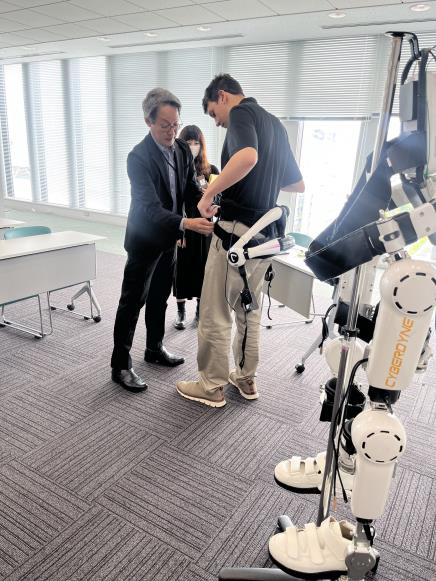
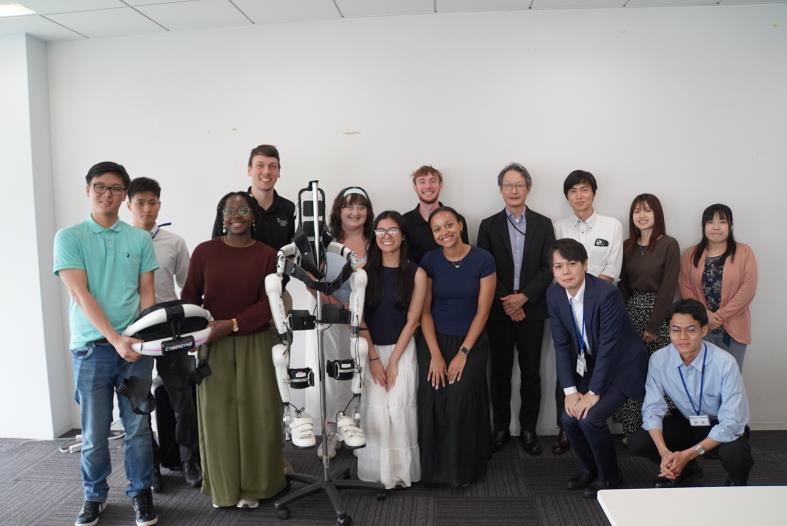
 On June 10th, our group visited Shonan Robo Care Center in Fujisawa. Japan is known as a “hyper-aging” society with over 30% of the population being over 65 years old. During the presentation, we learned about the idea of a “techno-peer support society,” where technology works alongside people to help individuals maintain independence and improve their quality of life. As Japan faces the challenges of an aging population, Shonan Robo Care Center is developing innovative technologies to support both older adults and their caregivers.
The highlight of the visit was learning about the HAL (Hybrid Assistive Limb), a wearable robotic device that assists with movement. We saw demonstrations of HAL devices designed for the arm, leg, and lower back. Using sensors on the skin, the devices can detect weak bio-electrical signals from the brain, triggering HAL to assist with movement. Through this process, feedback is sent back to the brain, helping the user regain motor function and improve their ability to move independently over time. I found it fascinating that the HAL device for the lower back can not only be used for rehabilitation but also to assist caregivers. I had mostly thought of assistive technology as something designed solely for patients. However, learning that the same technology can reduce physical strain on caregivers showed me how innovation can improve the caregiving experience as well. It reinforced the idea of a techno-peer support society, where technology works alongside people to support everyone involved in the care process.
Tim Rauck
Computer Science Major | University of Maryland, Baltimore County